


The responsibilities of a modern finance team have expanded so much that any predictability in scaling the function has essentially disappeared.
Where CFOs once stood at the stern analyzing the wake of the business, they’re now a strategic navigation partner to the CEO. You still oversee the close process and generate long-term forecasts. But you’re also expected to navigate go-to-market transitions — shifting from product-led to sales-led strategies, driving pricing model evolutions, managing complex systems and data infrastructure, and more.
None of that really fits with the linear rules of thumb for building a finance team.
To understand what it actually takes to scale finance today, we talked to Jaime Ortiz (CFO) and Brian Weisberg (VP of Business Operations and Strategic Finance) about how they’re thinking about building their finance function as Mux plans to double revenue in 2026.
What they offered isn’t a step-by-step checklist for scaling finance. Rather, they provided a set of principles to help you grow flexibly with business demands and the nuances of your situation.
The Traditional Stages of Building a Finance Team
The most common way to think about building a finance team is by stage according to revenue growth. While there are always nuances unique to every business, the idea is that business complexity roughly scales linearly with revenue growth. And that business complexity is what typically dictates hiring on the finance team.
You see this thought process in guides from people like CJ Gustafson at Mostly Metrics and OnlyCFO. As OnlyCFO writes, “building a great finance department starts with hiring the right people. But what many folks forget is that building great teams requires the right people at the right time.”
They present this cheat sheet for standard finance and accounting roles at different revenue bands.
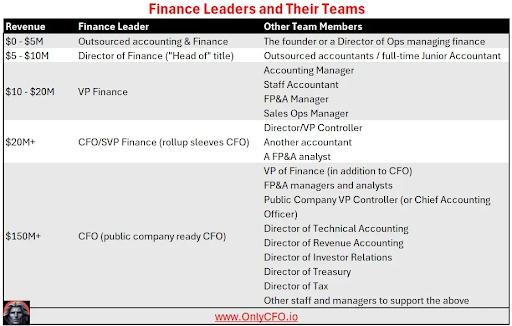
There, you see guidance for five growth tiers:
Early stage ($0 - $5M). Companies rely on outsourced accounting and outsourced finance leadership. Founders or a Director of Ops cover everything else.
Growth stage ($5M - $10M). A Director of Finance (often carrying a “Head of” title) steps in to run the model, coordinate planning, and manage outsourced bookkeeping.
Late growth stage ($10M - $20M). A VP of Finance enters the picture, and the team typically expands to include core accounting and FP&A roles, plus early sales operations support.
Scale-up stage ($20M+). A CFO or SVP of Finance takes ownership of the function, accompanied by a controller, an additional accountant, and a dedicated FP&A contributor.
Enterprise-level operations ($150M+). The organization begins to resemble an enterprise finance department with controllership, technical accounting, revenue accounting, tax, treasury, investor relations, and layered FP&A leadership.
This ladder makes a great starting reference point for thinking about the way finance teams have typically grown. But when asked about whether or not all of these guidelines still hold true for 2026, Brian said “I can’t help but overthink the question: what would Brian have said two years ago versus what I would say today?”
The landscape has changed enough that relying solely on these rules of thumb to build your finance team could lead you astray.
Why the Linear Model for Scaling Finance Breaks Down Today
That shift Brian described — the difference between what would have been “right” two years ago and what’s required today — comes down to how dramatically the operating environment has changed.
Business models are more complex. Hybrid PLG + sales motions, usage-based billing, self-serve funnels, enterprise contracts, and multi-product expansion all create complexity that a static revenue band can’t capture. And finance has more oversight of it all than ever before
Investor expectations diverge. A company backed by venture debt or private equity faces very different reporting and rigor requirements than a venture-backed company optimizing for speed and experimentation.
Systems and automation reshape what a small team can handle. Modern tooling (e.g. the growing wave of AI finance tools) lets a lean group deliver what previously required multiple specialist roles, blurring the old “hire at X milestone” guidance.
AI is changing the shape of the team. Automation now eliminates whole categories of manual work, which means hiring decisions depend less on throughput and more on adaptability, analytics fluency, and comfort working with new workflows.
These are all reasons why a strategic CFO needs to think beyond traditional frameworks for building a team. You don’t have to replace the model entirely, but you should adapt it to the realities of how your company operates today.
3 Principles for Scaling a Modern Finance Function
What actually determines the sequence of finance hires is the model you’re running, the systems you inherit, the reporting burden you carry, and the gaps in your own skillset.
That’s the crux of how Jaime and Brian are thinking about the finance function at Mux. Not in absolutes or generalized heuristics, but according to a certain set of principles for evaluating business and team needs.
1. Prioritize the Weak Leg of the Finance Function
Once you understand the business context, the next step is figuring out which part of the finance function needs reinforcement. This is where Brian’s “three-legged stool” analogy is actually useful: every finance org balances accounting (looking backward), FP&A (looking forward), and business operations (keeping the machine running day to day).
Most CFOs naturally lean toward one or two of these legs, which means one of them is almost always underpowered.
That’s where your hiring priority comes from.
If your path to CFO is through FP&A, the weak leg may be controllership or revenue accounting. If you’re an operator at heart, you may need a true model owner earlier than the traditional sequence suggests. And if the business is heavily dependent on billing or GTM precision, the gap may be in sales ops or data-oriented biz ops.
This is also where the “bench” comes into play. Jaime describes it as understanding the pool of roles available to you — not just the standard trio of accounting, FP&A, and finance leadership, but the adjacent functions that often carry disproportionate impact:
SalesOps/RevOps. Critical in sales-led or hybrid motions where pipeline, comp structure, and CRM hygiene drive revenue accuracy.
Analytics/Business Intelligence. Increasingly the foundation for planning, forecasting, and product-usage visibility — the systems-minded people who understand how your tech stack integrates and can translate that into decision-ready data. Jaime noted this is always the first gap she fills (particularly the business analytics layer that connects financial and operational systems rather than product-level data science).
Controller/Rev Accounting. Essential earlier than expected in usage-based models or audit-heavy environments.
By mapping these roles against the three legs of the stool, CFOs get a clearer view of where the imbalance actually sits.
2. Default to Generalists and Expect Specialists to Play a Hybrid Role
Modern finance teams get more leverage from adaptable operators than from narrow experts. Generalists can shift between modeling, GTM support, systems cleanup, revenue analysis, and whatever else the business needs at that moment. That flexibility matters more than depth until the work becomes genuinely specialized.
“I’ve never found that I’ve hired someone who skewed too general. If anything, the pitfall is hiring someone too specialized.” — Jaime Ortiz
Automation and AI make it possible to go further with smaller, more hybrid teams by removing increasing amounts of manual throughput. As the work evolves, even technical roles have to operate with broader context. Even “modern-day accountants can’t just be scorekeepers,” said Brian. “They have to understand the needs of the business and align the scorekeeping with decision making.”
What used to be a straightforward “start with generalists, then hire specialists” principle has become:
Start with generalists who can handle ambiguity and move fluidly across priorities.
Delay specialization until the business model, risk profile, or reporting requirements genuinely demand depth.
Expect specialists to operate like hybrid players rather than staying confined to a narrow lane.
When you get to a level of scale where you’re considering an IPO or another type of exit, you might start bringing on increasingly specialized roles. But until that point, you’ll get further with a more nimble team willing to embrace somewhat fluid roles.
3. Scale Through Systems First and People Second
The concept of scaling a finance team has traditionally revolved entirely around “who to hire and when.” That’s still important, but scaling now happens first and foremost through data and systems.
Clean data, integrated workflows, and automation create far more leverage than simply adding bodies, which is why Jaime would recommend hiring for this competency first if you’re building a team from scratch.
She said “the first person I’m hiring is someone who can build out our analytics capability — not a data scientist or a product analyst, but someone who understands how data flows across billing, CRM, product, and payroll systems and can turn that into reliable, self-serve reporting for the business.” Because without a reliable data foundation, FP&A, revenue analysis, GTM support, and even basic forecasting become heavier lifts than they need to be.
But this doesn’t mean that the finance function should own analytics across the entire organization. Product teams need their own analytical muscle, which typically belongs under engineering or product leadership. CFOs should focus specifically on the business intelligence and systems integration layer — the connective tissue between your financial systems and the rest of the business. That cross-functional data foundation is a natural fit for the finance org because it maps directly to the metrics the business is accountable for.
Scaling with this focus on data and systems has two effects. It delays the need to add headcount. And it also changes the profile of who belongs on the team when you do decide to hire.
“You need to hire people who aren’t afraid of exploration. They have to be early adopters these days, whether it’s AI or simple automation. Sometimes you just need to get out of a spreadsheet. Close Excel.” — Brian Weisberg
A strong focus on your data foundation, AI, and automation is what enables you to get further with a tight team of generalists. It’s what breaks you away from scaling the finance function linearly with headcount as your team accomplishes more with less.
Pitfalls to Avoid When Building Your Finance Team
Even with the best intentions, certain mistakes tend to show up again and again when finance teams grow. Jaime and Brian have both been through multiple cycles of building, shrinking, and rebuilding their organizations, and their experiences point to a few pitfalls worth steering clear of:
Hiring specialists too early. Range matters more than depth in the early innings. Hiring someone too specialized too early can create unnecessary constraints later.
Overvaluing big-company experience. It’s critical to understand what someone actually built. Jaime’s approach: look closely at a potential hire’s previous roles and understand “what existed when they got there versus what existed when they left.”
Prioritizing confidence over curiosity. Brian looks for people who approach problems with genuine interest rather than canned answers: “You need folks that listen first and speak second.”
Bringing in managers instead of doers. Early-stage and mid-stage finance functions need players, not overseers. As Brian said, “I want scrappy Swiss Army knives, not people eager to manage armies.”
Assuming roles will stay static. Even well-defined jobs evolve quickly in the current business environment we’re all operating in. The team has to expect responsibilities to shift as the business shifts.
A modern finance function avoids these traps by staying flexible, hiring for adaptability, and building the organization around the realities of the business.
Where Finance Leaders Get the Support to Build Modern Teams
Modern finance teams aren’t built by following a predefined ladder. They take shape around the realities of the business — the model you’re running, the complexity you’re carrying, and the capabilities you need to unlock the next phase. Jaime and Brian’s experiences at Mux show how often those needs shift, and how important it is to stay flexible in how you design the function.
There’s no single right answer for when to hire, who to hire, or how to structure the work. That ambiguity is exactly why having a trusted peer group matters. CFOs need a place to pressure-test decisions, compare approaches, and tap into operators who have solved similar problems before.
That’s what The F Suite offers: a community of senior finance leaders who share real operating experience. The kind of perspective that makes these decisions faster, clearer, and more grounded in what actually works. If you want that network in your corner, you can apply to join The F Suite.